Seville · Almohad Monument
Torre del Oro, Seville
The 13th-century Almohad defensive tower watching over the Guadalquivir river. Everything you need to know before visiting.
- 1220-1221Built
- 36 mHeight
- 12Sides
- 3 €Admission
On this page
The Torre del Oro (the "Tower of Gold") is a 13th-century Almohad defensive watchtower standing along the banks of the Guadalquivir river in Seville. Over eight hundred years, it has served as a military fort, a prison, a chapel, a gunpowder warehouse, and a port authority office. Today it houses the Seville Naval Museum and remains, alongside the Giralda, the most iconic silhouette in the Seville skyline.
What is the Torre del Oro
Technically, the Torre del Oro is an albarrana tower: a defensive tower detached from the main city wall and connected to it by a fortified corridor known as a coracha. This architectural design allowed defenders to flank attacking enemies and, in Seville's case, physically monitor and control all river traffic entering the city.
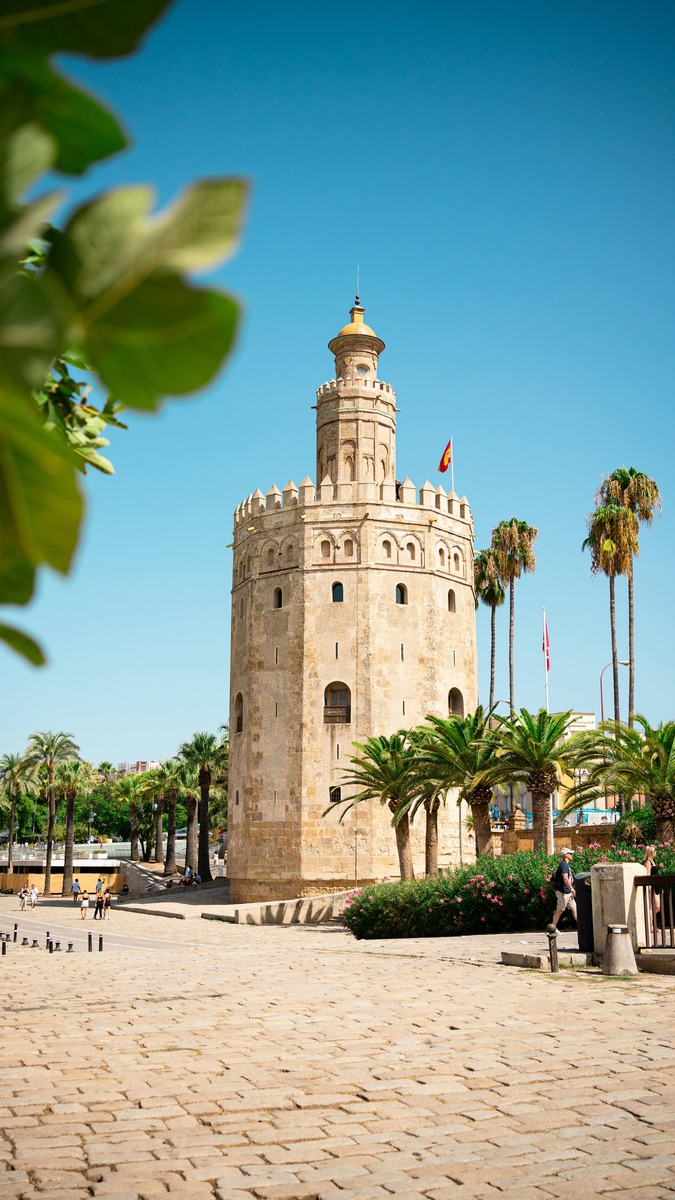
The tower has an uncommon dodecagonal (12-sided) floor plan. Because of this geometry, the building seems to shift shapes depending on the angle from which you view it. It stands roughly 36 metres tall and consists of three clearly superposed tiers built across three different historical periods:
- First tier (1220–1221). The original Almohad base, dodecagonal, built of ashlar masonry and pressed mortar. This massive base supports the entire weight of the tower.
- Second tier (14th century). Also dodecagonal but visibly narrower, added during the Christian reign of King Peter I of Castile.
- Third tier (1760). A circular lantern topped with a golden tiled dome. It was designed by military engineer Sebastián Van der Borcht (the architect behind Seville's Royal Tobacco Factory) to repair heavy structural damage caused by the Great Lisbon Earthquake of 1755.
This unusual superposition of eras gives the tower its distinctive appearance: a severe 13th-century Moorish military bastion crowned by an elegant 18th-century baroque lantern.
Where is the Torre del Oro located
It is located at Paseo de Cristóbal Colón, s/n, 41001 Seville, on the eastern (left) bank of the Guadalquivir river in the historic Arenal district. It sits squarely between the San Telmo Bridge and the Isabel II Bridge (commonly called the Triana Bridge).
Its central location makes it effortless to fit into any sightseeing itinerary: it is approximately 700 metres from Seville Cathedral and the Giralda, 500 metres from the Royal Alcázar, and less than 10 minutes on foot from the Maestranza Bullring. The closest metro stop is Puerta de Jerez (Line 1), just a 5-minute flat walk away.
Explore all walking routes, transit options and directions to the Torre del Oro.
Hours, admission prices and tickets
| Detail | Information |
|---|---|
| Monday to Friday | 9:30 – 18:45 |
| Saturdays and Sundays | 10:30 – 18:45 |
| General admission | 3 € |
| Free admission | Mondays (all day) |
| Average visit time | 30 – 45 minutes |
| Telephone | +34 954 22 24 19 |
See the complete guide on tickets, opening hours, and discounts.
What to see inside
The interior of the tower houses the Seville Naval Museum, curated by the Spanish Navy since 1944. While the interior space is naturally compact due to the 12-sided fortification walls, the exhibition is thoughtfully laid out over two gallery floors.
The exhibits include early navigational instruments (astrolabes, quadrants, and compasses), historic maritime charts tracing Atlantic trade routes, detailed scale models of historic Spanish galleons, a 16th-century bronze cannon, a 19th-century ship figurehead, and maritime flags detailing Seville's historic role in the Indies Fleet.
The tour culminates by climbing a narrow spiral stone staircase to the open-air rooftop terrace. From here, you have an unobstructed panorama across the Guadalquivir river in both directions, looking directly across to the Triana neighbourhood, down over the riverfront promenades, and inland toward the Giralda. For many visitors, this 360-degree viewpoint is the highlight of the visit.
Learn more about the Naval Museum and its maritime collections.
Why is it called the Torre del Oro (Tower of Gold)
The popular folktale claiming that the tower was used to store gold brought back from the Spanish Americas is completely false. In colonial times, all gold and silver shipments were required by law to be officially registered, weighed, and stored at the Casa de la Contratación (House of Trade). Furthermore, contemporary 13th-century chronicles prove the tower was already called the Torre del Oro centuries before Christopher Columbus ever sailed.
Two well-grounded historical explanations account for the name:
- The lime and straw mortar. The exterior was originally coated in a compacted mixture of lime, sand, and pressed straw. When struck by the low morning or evening sun, this coating cast an intense golden reflection onto the surface of the river. Archaeological restoration work has confirmed the presence of this original coating.
- Glazed yellow tiles. Another theory suggests that parts of the Almohad battlements may have originally been adorned with golden-yellow ceramic tiles that reflected the Andalusian sunlight.
Read the full history of the tower: who built it, when, and how it was saved from demolition.
Interesting facts about the Torre del Oro
- The Great River Chain. In Moorish times, a heavy iron chain was anchored to the base of the tower and stretched all the way across the Guadalquivir to the opposite bank in Triana, blocking enemy ships from sailing upriver into the city. In 1248, Castilian admiral Ramón de Bonifaz rammed and severed the chain with his fleet, leading to the capture of Seville by King Ferdinand III.
- It has a sister tower. The octagonal Torre de la Plata (Tower of Silver) was built at the same time as part of the same outer defensive system. It still stands today, tucked between residential apartment blocks on Calle Santander, just a short walk away.
- It was almost demolished. In the mid-19th century, city planning officials proposed tearing the tower down to widen the river docks. Furious protests by local Seville citizens and cultural figures successfully prevented its destruction.
- Its twelve sides are not identical. Although dodecagonal, the alternating wall facets vary slightly in width, creating the optical illusion that the tower changes shape as you walk around it.
- It is an official Spanish Heritage Site, having been declared a national Historic-Artistic Monument in 1931.
Tips for your visit
- Go early or late in the afternoon. Mid-morning tends to see tour groups arriving, and the narrow spiral staircase only allows visitors to walk in single file.
- Monday is free entry. While admission is free all day on Monday, expect longer queues. Arriving right at the 9:30 AM opening time is recommended.
- Accessibility note: The upper museum floor and the rooftop terrace are accessible only via a steep spiral stone staircase without a lift. The ground floor gallery is accessible from street level.
- Combine it with a riverside walk. The monument is just as enjoyable from the outside. Walk along the riverbank north toward the Triana Bridge, or cross over to Calle Betis for sunset views. Sightseeing river cruises on the Guadalquivir depart from the dock right below the tower.
- For the best photograph, cross to the Triana side of the river in the late afternoon when the setting sun illuminates the tower's riverfront façade.
Browse our photo gallery and best vantage points to photograph the tower.
Frequently Asked Questions
What is the Torre del Oro in Seville?
It is a 12-sided (dodecagonal) Almohad defensive watchtower built between 1220 and 1221 to protect Seville and control river traffic along the Guadalquivir. Today it houses the Seville Naval Museum.
Where is the Torre del Oro located?
On Paseo de Cristóbal Colón, s/n, 41001 Seville, on the left bank of the Guadalquivir river between San Telmo Bridge and Isabel II Bridge (Triana Bridge).
How much does admission to the Torre del Oro cost?
General admission is €3. Entry is free for all visitors on Mondays. Check current rates and hours before visiting, as military ceremonies can occasionally affect schedules.
How long does a visit to the Torre del Oro take?
Between 30 and 45 minutes. The visit covers the Naval Museum galleries on the lower two floors and the open-air rooftop terrace overlooking the river and the historic centre.
Why is it called the Torre del Oro (Tower of Gold)?
The most widely accepted explanation attributes the name to the golden reflection that its original lime-and-straw mortar coating cast onto the river in sunlight. The legend that American gold was stored here is false: precious metals were registered at the Casa de la Contratación.